
About the Journal
Hadharatuna: Journal of Islamic History and Civilization is a leading scientific journal that focuses on publishing cutting-edge research in the History of Islamic Civilization. With a research scope that covers various aspects of history, this journal aims to support the development of innovative science and practical applications that can answer global challenges. Hadharatuna focuses on publishing scientific works that cover various disciplines in the scope of culture and tradition, civilization, local wisdom, heritage and architecture, biography, and historiography. Hadharatuna: Journal of Islamic History and Civilization is published 2 editions every year in March and October.
| ..:: Journal Identity ::.. |
||
| Title | : Hadharatuna: Journal of History and Islamic Civilization | |
| e-ISSN | : (-) | |
| Issue Frequency | : March and October | |
| DOI Prefiks | : (-) | |
| Main Indexing | : (-) | |
| Publisher |
: STAI Riyadul Ulum Condong Tasikmalaya | |
| Editor in Chief | : Deden Gumilang Masdar Nurulloh, M.Hum. |
|
| Managing Editor | : Dandie Hambaliana, M.Hum. |
|
| License | : Creative Commons Attribution-ShareAlike 4.0 International | |
Hadharatuna: Journal of Islamic History and Civilizationhas been indexed by :
 |
 |
 |
 |
 |
 |
 |
 |
 |
 |
 |
|
This journal is also available on several library catalogues:
 |
 |
 |
 |
 |
 |
 |
 |
Current Issue
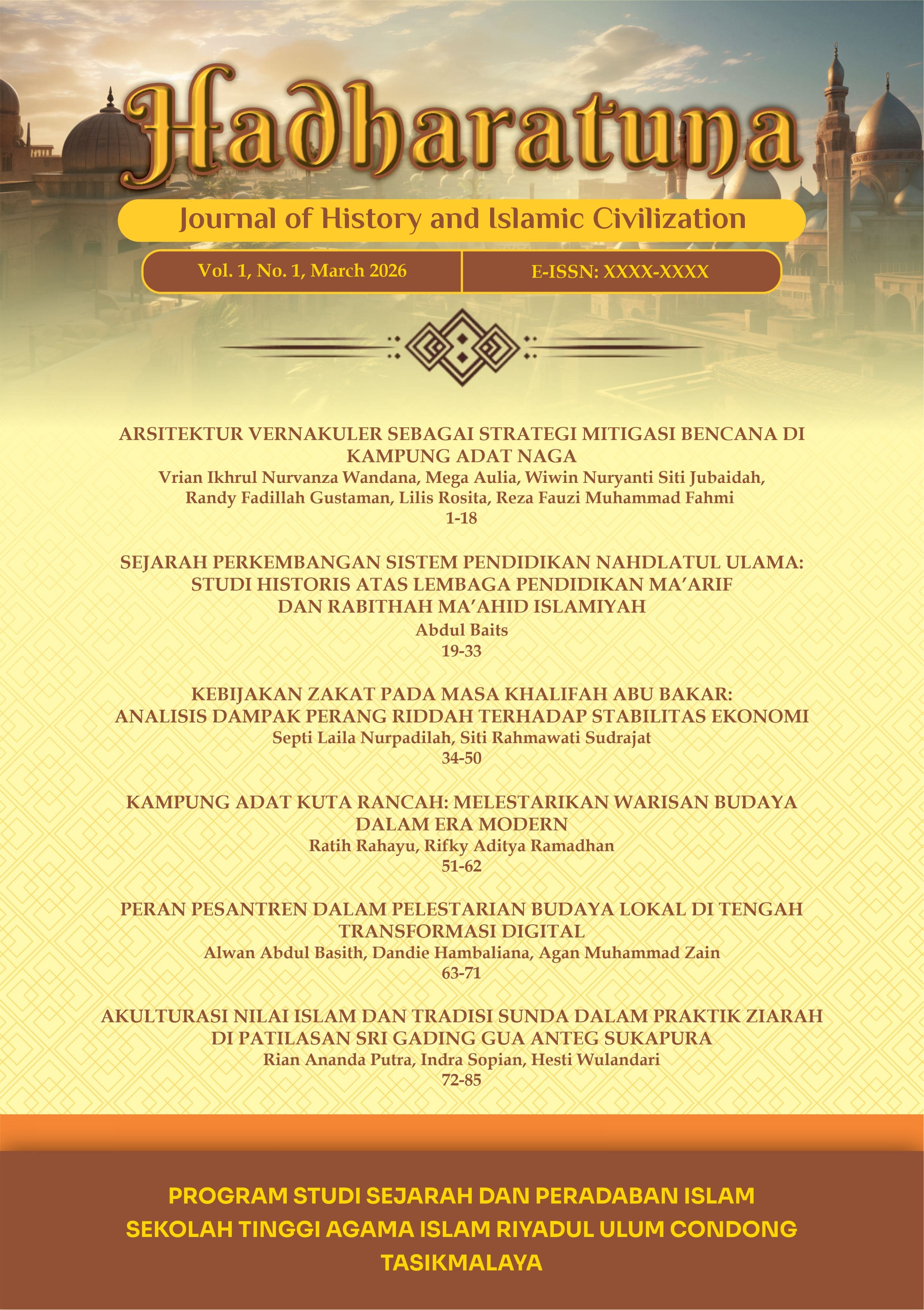
This edition presents a collection of scholarly articles exploring the relationship between Islam, local culture, and social dynamics in both historical and contemporary contexts in Indonesia. The contributors come from various academic institutions, including Siliwangi University, STAI Riyadul Ulum Condong, STIT Az Zahra Tasikmalaya, Indonesia Open University, Universitas Muhammadiyah Sukabumi, and Sunan Gunung Djati State Islamic University Bandung. The articles address topics such as vernacular architecture for disaster mitigation, the development of Nahdlatul Ulama’s educational system, zakat policy during Abu Bakr’s caliphate, cultural preservation in Kampung Adat Kuta, the role of pesantren in the digital era, and the acculturation of Islamic and Sundanese traditions in pilgrimage practices. Overall, this edition highlights interdisciplinary insights linking history, Islamic education, local culture, and community resilience, with both theoretical and practical relevance.


