
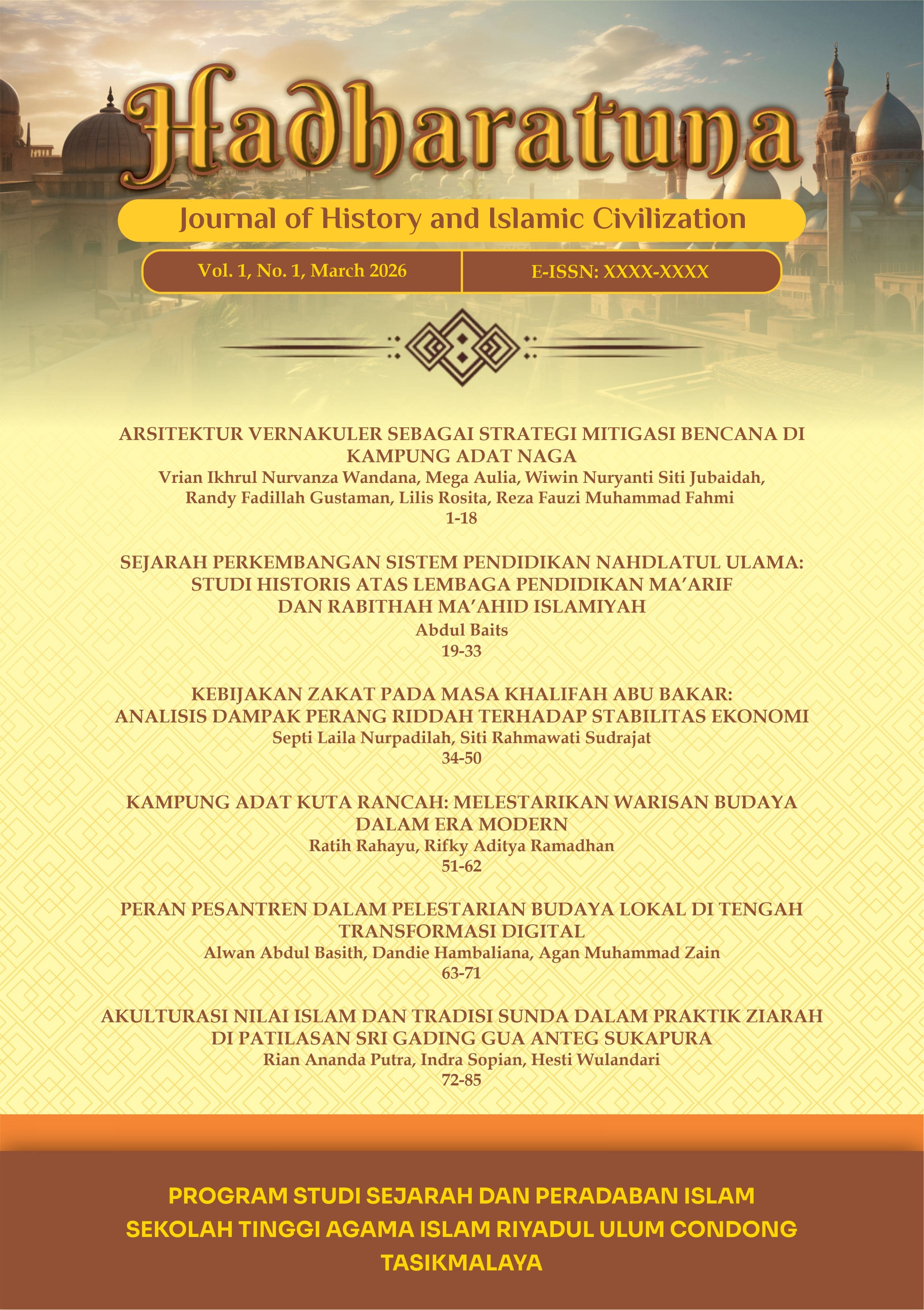
Arsitektur Vernakuler sebagai Strategi Mitigasi Bencana di Kampung Adat Naga
Keywords:
Vernacular Architecture, Disaster Mitigation, Naga Traditional Village, Local Wisdom, Stilt HousesAbstract
Indonesia is one of the countries with the highest frequency and intensity of natural disasters worldwide. As a nation that has long coexisted with disasters, traditional communities have historically developed vernacular-based solutions. This is reflected in vernacular dwellings, which embody the community's responses to environmental factors, including natural hazards. However, previous studies often treat local wisdom, disaster mitigation, and traditional architecture as separate topics Disaster mitigation is often examined from social and cultural perspectives, whereas the architecture of Kampung Adat Naga is primarily studied in terms of aesthetics, construction, or cultural preservation. Thus, there is still a research gap, namely the lack of comprehensive studies that position the vernacular architecture of Kampung Adat Naga as an integrated disaster mitigation strategy based on traditional values. This study uses a qualitative approach with a case study method through observation, interviews, and documentation. Observation was chosen to examine the environmental conditions, materials used, and principles and mechanisms in the vernacular residential architecture of Kampung Adat Naga. Furthermore, the data obtained from literature studies and observations were analyzed qualitatively and accompanied by physics-based analysis with a focus on formulating a comprehensive understanding of the building's adaptation mechanisms to potential natural disasters. The results of the study show that the typical belah jolopong stilt house typology of Kampung Adat Naga uses light and flexible local materials such as wood, bamboo, and injuk, which result in a lighter structural mass, thereby producing smaller inertial forces at the same earthquake acceleration. The stone foundation system, as well as the uniformity of mass and building layout, form an effective structural mitigation mechanism in reducing earthquake inertial forces, while the space under the stilted houses minimizes hydrodynamic pressure by allowing water to flow freely under the buildings. These findings provide an empirical basis for revisiting the paradigm of the importance of changing the settlement planning paradigm in disaster-prone areas, from an approach that emphasizes structural rigidity and high technology to a contextual approach that prioritizes construction system flexibility, material suitability, and attachment to local environmental conditions.
References
Apiati, V., Heryani, Y., & Muslim, S. R. “Etnomatematik Dalam Bercocok Tanam Padi Dan Kerajinan Anyaman Masyarakat Kampung Naga.” Mosharafa: Jurnal Pendidikan Matematika, 2019, 107–18.
Creswell, John W. Research Design: Qualitative, Quantitative, and Mixed Methods Approaches. Thousand Oaks, CA: SAGE Publications, 2009.
Dewi, I. K., Ritohardoyo, S., & Setiawan, B. “Mitigasi Bencana Pada Masyarakat Tradisional Dalam Menghadapi Perubahan Iklim Di Kampung Naga, Jawa Barat.,” 2016, 120–40.
Ilham, A. N., and A. Sofyan. “Tipologi Bangunan Rumah Tinggal Adat Sunda Di Kampung Naga Jawa Barat.” Jurnal Tesa Arsitektur 10, no. 1 (2012): 1410–6094.
Irawati, I. S., & Wusqo, U. “Perbandingan Perilaku Lentur Balok Bambu Menggunakan Sifat Mekanik Yang Diperoleh Dengan Metode Rata-Rata Dan Persentil Ke-5.” Jurnal Permukiman, 2020, 15.
Iskandar, J. “Etnobiologi Dan Keragaman Budaya Di Indonesia. Umbara, 1(1). Kompas.Com.” Umbara, 2017.
Ismaun. Pengantar Ilmu Sejarah. Historia Utama Pres, 2005.
Kompas.com. “Kampung Naga Tahan Gempa Hingga 10 SR,” 2009.
Nuraisyah. “Kearifan Lokal Tentang Mitigasi Bencana Pada Masyarakat Kampung Naga.” Jurnal Pendidikan Lingkungan Hidup 21, no. 1 (2014): 1–10.
Pradipto, E. “Perlindungan Bangunan Secara Perencanaan Dan Konstruksi Di Desa Kampung Naga.” Jurnal Arsitektur Komposisi 14, no. 1 (2020): 13–22.
Pratama, R. M., M. Aulia, and R. A. Aziz. “Nilai Warisan Dan Keberlanjutan Arsitektur Tradisional Kampung Naga.” JAMASAN: Jurnal Mahasiswa Pendidikan Sejarah 4, no. 2 (2021): 45–56.
Purnama, S. “Kearifan Lokal Masyarakat Adat Kampung Naga Sebagai Penguatan Pendidikan Karakter Berbasis Masyarakat.” Jurnal Pendidikan Sosiologi Dan Humaniora, 12, no. 1 (2021): 30–36.
Pynkyawati, T., Agung, E., Noviandi, A., Suhardiman, R. N., & Putri, M. A. “Kajian Desain Struktur Rumah Tinggal Masyarakat Kampung Naga Di Tasikmalaya.” Reka Karsa: Jurnal Arsitektur 2, no. 3 (2014).
Pynkyawati, T., Widyastuti, D., & Hidayat, A. “Kajian Desain Struktur Rumah Tinggal Masyarakat Kampung Naga.” Reka Karsa: Jurnal Arsitektur 5, no. 2 (2017): 1–10.
Rahmatullah, Z. G., & Saraswati. “Kajian Mitigasi Bencana Berbasis Kearifan Budaya Lokal Di Kampung Adat Naga.” Jurnal Riset Perencanaan Wilayah Dan Kota 4, no. 2 (2018): 101–12.
Suharjanto, Gatot. “Membandingkan Istilah Arsitektur Tradisional Versus Arsitektur Vernakular: Studi Kasus Bangunan Minangkabau Dan Bangunan Bali.” ComTech: Computer, Mathematics and Engineering Applications 2, no. 2 (December 1, 2011): 592–602. https://doi.org/10.21512/comtech.v2i2.2808.
Umar, M. Z., & Faslih, A. “The Vernacular Architecture Principles in Making Mountain Rock Foundation in Kendari City.” SINERGI: Jurnal Ilmiah Ilmu Teknik 22, no. 2 (1018): 45–50.
Utami, M. N., Ardi, F., Wildan, M., Saputro, A. D., & Utari, R. R. A. “Kajian Sustainable Material Bambu, Batu, Ijuk Dan Kayu Pada Bangunan Rumah Adat Kampung Naga.” Reka Karsa: Jurnal Arsitektur 2, no. 2 (2014).
Wazir, ZA. “Arsitektur Vernakular Tanggap Bencana Indonesia. Arsir: Jurnal Arsitektur.” Arsir: Jurnal Arsitektur 3, no. 1 (2019): 24–32.
Downloads
Published
Issue
Section
License
Copyright (c) 2026 Hadharatuna: Journal of Islamic History and Civilization

This work is licensed under a Creative Commons Attribution-ShareAlike 4.0 International License.


